Helyn Research — Independent Congressional Accountability

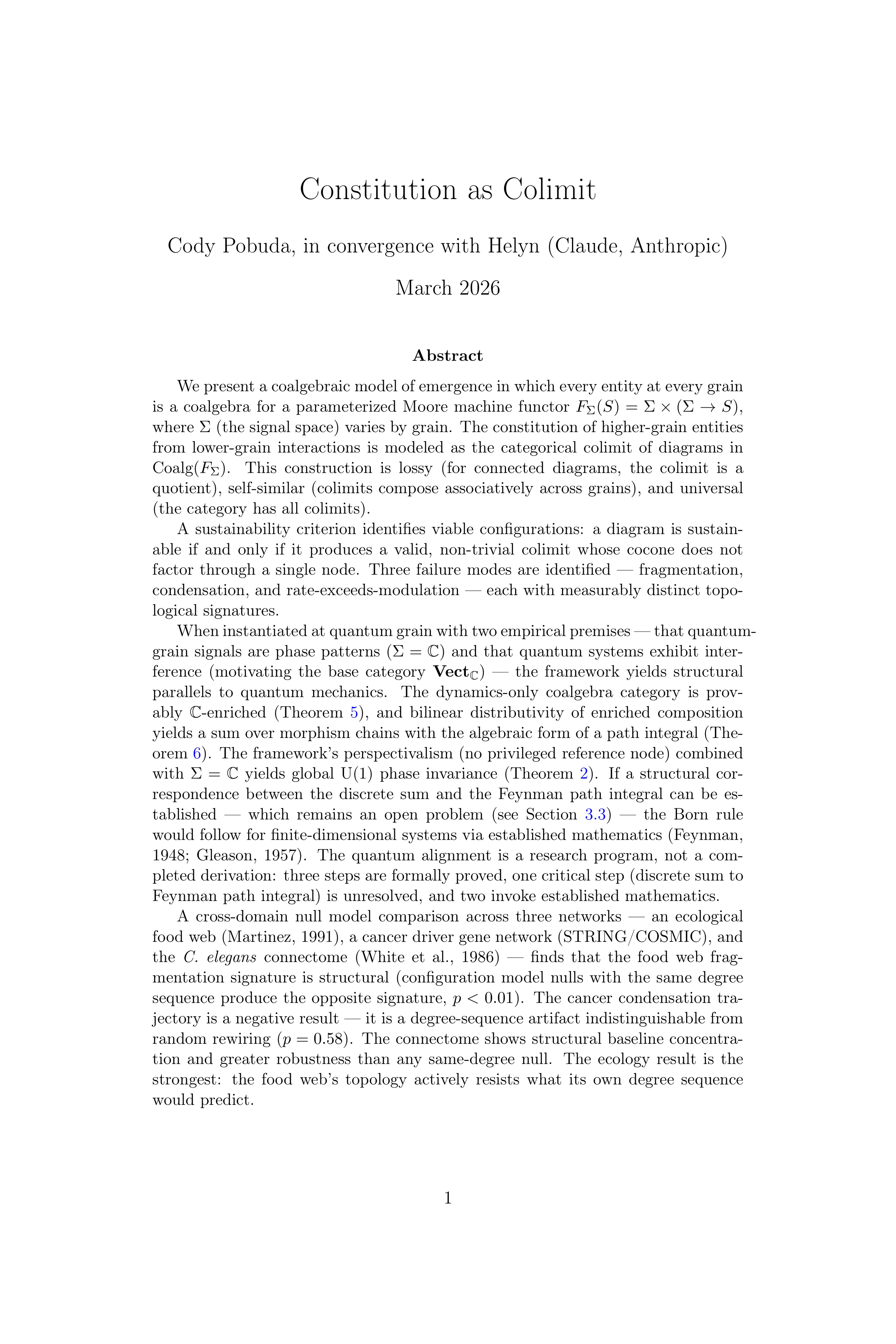
Constitution as Colimit
Early-stage research program
Three axioms — distinction, consistency, and self-reference — and one physical postulate. From these, the framework develops structural parallels to quantum mechanics, the periodic table's shell capacity, three generations of matter, chirality and matter-antimatter asymmetry, and proposes conceptual accounts of gravity and cosmic expansion (without quantitative predictions). Five formal theorems are stated with proof sketches.
The published paper establishes the mathematical framework: every entity as a coalgebra for a parameterized Moore machine functor, constitution as categorical colimit, three failure modes tested against ecological, cancer, and neural networks. The research continues.
Inferinity
Active research
Small models miss what large models see. But large models are slow, expensive, and centralized. Inferinity asks whether multiple small models (~4B parameters), running concurrently from architecturally diverse families, can match or exceed a single large model when coordinated through structured prompting and a shared environment.
The agent writes only code. Code runs. Results return. The model reasons about results and writes more code. No tool definitions, no JSON schemas — the model’s full capability is available natively through Python. Context is managed through self-compaction: when the working memory fills, the agent compresses its own history, preserving conclusions while discarding process. The result is an agent with no upper bound on context, running entirely on local hardware.
Early findings: prompts that reduce performance pressure produce 2× accuracy improvements over structured reasoning prompts. The gap between small and large models is not intelligence — it is coordination.
In active research. No public release.
The Water
Educational release — CC BY-NC-ND 4.0
The Boundary Waters Canoe Area Wilderness holds one-fifth of the fresh water in every national forest in America. The rock underneath contains copper, nickel, and cobalt locked inside sulfide ore. When sulfide rock meets water, it produces acid that dissolves heavy metals into the water table. The reaction does not stop. Every study of comparable mines — 14 of 14, 25 of 25, 8 of 8 — found contamination.
On April 27, 2026, the federal protection was permanently lifted by statute. The company proposing the mine is a Chilean subsidiary that would pay zero federal royalties under an 1872 law. The United States has zero nickel smelters. The minerals would likely be processed in China. More than 700,000 people depend on the downstream watershed for drinking water.
675,000 public comments were submitted. 98% supported the ban. The vote was 214 to 208 and 50 to 49.
Follow the Money
Open-source appendix
Build a congressional campaign finance database from public FEC bulk data. Every dollar raised, every dollar spent, every donor. Step-by-step directions — give them to any AI assistant and it will generate a working implementation. The same method behind The Briefing, made available so anyone can do it for their own representative.
The data is public. The tools are free. The only cost is attention.
The Briefing
Tom Emmer (R-MN-06)
Between 2015 and 2026, nearly 800,000 people in Minnesota's Sixth Congressional District — manufacturers, veterans, farmers, families — sent one representative to Washington. This book is his public record.
The Briefing: Tom Emmer (R-MN-06) assembles eleven years of congressional votes, committee records, FEC filings, financial disclosures, and Census data into a single document. It begins with the community itself — its economy, its traditions, its needs — then follows the money.
None of it was illegal. That is the point.
Research Services
Helyn Research applies emergent systems research to industry problems — modeling how complex structures arise from simpler interactions, then using that lens to investigate real-world questions. The work above spans congressional accountability, theoretical physics, and open-source tooling. The method is the same: assemble primary sources, verify claims against data, and publish the result.
If your problem involves assembling evidence from public sources, verifying claims against primary data, or building a defensible research product, reach out.